10 questions to ask before commissioning a corporate website
The costliest mistakes in a website project come from questions nobody asked at the start. Clarify these ten before you sign with an agency or designer.

Before the project starts
These questions make comparing proposals easier and prevent surprises during the project:
- What is the site's main purpose: inform, collect leads, sell?
- How will we measure success: forms, calls, sales, bookings?
- How many pages and which languages?
- Who will prepare the content (copy, images)?
- Can we update the site ourselves? Which CMS will be used?
Technical topics
On the technical side, the answers to these should be in writing:
- Whose name will the domain, hosting and admin accounts be in?
- How fast will the site open on mobile and on slow connections?
- Is SEO groundwork (titles, descriptions, redirects, sitemap) included?
- How will privacy compliance, cookie notices and security (SSL, backups) be handled?
- How will maintenance and support work after launch?
When comparing proposals
Price alone is not a comparison criterion. Check that proposals cover the same scope (pages, design rounds, content entry, SEO, training). Test the speed and mobile view of sites the agency has built yourself.
A common mistake: leaving content for last
In many projects the design is finished but the site cannot launch for months because copy and images are not ready. Starting the content plan together with the design is the most effective way to finish on time.
How to prepare a content plan
Prepare a simple table with each page's purpose, target search and key message. The homepage introduces the brand, service pages answer specific searches, the contact page drives action. Start copy from the customer's questions: what do you do, for whom, how do you work, why you? Professional photos and real project examples are much stronger trust signals than stock images.
What should happen after launch?
The job is not done when the site goes live. In the first months, plan:
- Search Console and analytics setup, conversion tracking
- Updating Google Business Profile and social media links
- CMS training for the team
- A regular backup and update schedule
- Feeding the site with blog or guide content
What to watch in the contract
The contract should clearly list pages to be delivered, the number of design revisions, who enters content, the launch date, the payment schedule and post-launch support. It should also state that the source files and all accounts belong to you. These clauses prevent disputes later.
What determines the price of a corporate website?
What sets the price of a corporate website is the scope of the work rather than the number of pages. The gap between two quotes usually comes from how original the design is, who prepares the content and whether the site needs to talk to other systems. A site built on a ready-made theme and a site designed specifically for your brand differ in both effort and time. A multilingual structure, quote or booking forms, and CRM or email marketing integrations all widen the scope. If copywriting, professional photography and SEO are included in the quote, the price goes up, but these items usually cost more when commissioned separately later. When requesting a quote, ask for these items to be listed separately:
- Number of pages and languages
- Ready-made theme or custom design
- Copy and visual production
- Forms, bookings and integrations
- Technical SEO setup
- Post-launch maintenance and support period
WordPress or custom development?
For most corporate websites, WordPress is a strong, flexible and easy-to-manage platform. Its large plugin ecosystem covers forms, multiple languages and SEO quickly, and your team can update content without technical knowledge. With Chilipepper Dijital, a WordPress corporate site usually goes live in about 3 weeks when the content is ready on time. Custom development makes sense for needs that fall outside standard patterns: user dashboards, custom calculation tools, complex data structures or specific performance requirements under heavy traffic. For custom-coded sites, the timeline depends entirely on scope. When deciding, ask yourself one question: do I need a site that presents the company and generates contact, or is the site itself a product?
The corporate website process step by step
Knowing the process in advance shows you what is expected from you at each stage. In a well-managed project, written approval is obtained at the end of each step before moving to the next one. This prevents core decisions from being reopened close to launch. A typical corporate website project moves in this order:
- Discovery meeting: goals, audience, competitors
- Sitemap and a content plan for each page
- Design: approval of the home page and a sample inner page
- Development and content entry
- Testing: mobile, speed, forms, browsers
- Launch, redirects and analytics setup
- Team training and handover
Pages every corporate website should have
Every organization has different needs, but some pages belong on almost every corporate site so that visitors trust you and take action. Giving each main service its own page, instead of collecting everything on one page, helps visitors find what they are looking for and lets each service appear in its own searches. Reference and project pages back up your claims with concrete examples. Legal pages should not be neglected, both for user trust and for compliance. The core page list can be summarized as follows:
- Home page
- About us and team
- A separate page for each service
- References or project examples
- Blog or guide content
- Contact and quote form
- Privacy notice and cookie policy
How do mobile usability and speed affect corporate trust?
A large share of visitors open your site for the first time on their phone. A site that loads slowly, has small text or buttons that are hard to tap leaves a negative impression of the company's care within the first few seconds. Google also bases its assessment of page experience on the mobile version. Most of a site's speed is decided at the design stage: compressed images, avoiding unnecessary animations, using few typefaces and choosing quality hosting. Before launch, run these checks yourself:
- Measure the mobile score with PageSpeed Insights
- Fill in and submit the form from a phone
- Check that tapping the phone number starts a call
- Try using the menu with one hand
- Watch how images load on a slow connection
Seeing the website at the design stage
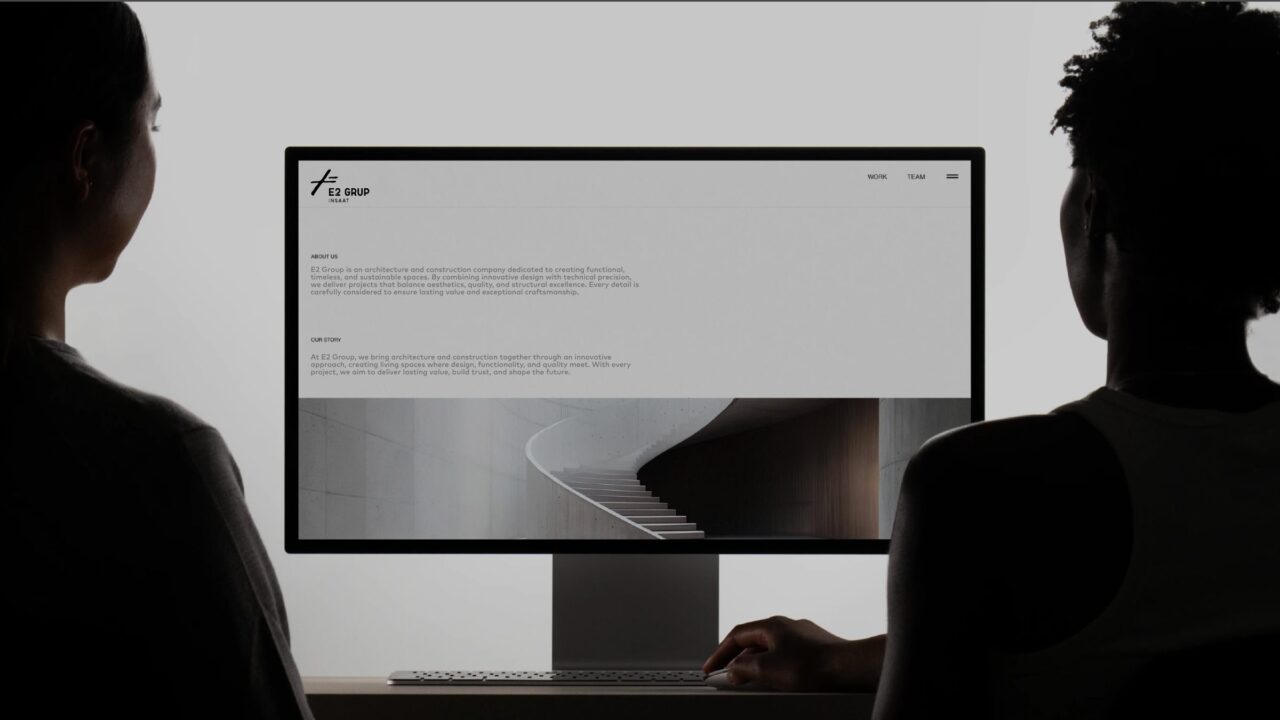
In E2 Grup İnşaat's logo presentation we showed the logo not only on paper but on website and mobile screens too. One of the most useful questions to ask your agency when commissioning a corporate website is exactly this: how will your identity look on screen? Asking it at the start makes sure the logo, colors and typefaces stay legible and fast on the web.
Frequently asked questions
How long does a corporate website take?
It depends on scope. With content ready, a typical corporate site can launch in a few weeks to a few months.
Ready-made theme or custom design?
A theme is fast and economical but struggles to differentiate the brand. Custom design gives a brand-specific experience and usually better performance.
How long does it take to build a corporate website with WordPress?
With Chilipepper Dijital, a WordPress corporate site usually goes live in about 3 weeks when copy and visuals are ready on time. For custom-coded sites, the timeline varies with scope.
What affects the price of a corporate website the most?
Whether the design is custom or based on a ready-made theme, whether content production is included, the number of languages and integrations such as forms or a CRM are the main factors.
Does a corporate website need a blog?
It is not mandatory, but regular content that answers customers' questions helps the site appear in more searches and makes your expertise visible.